Health Is Vital

Health is taken for granted, until you can't any more. In this blog I hope to put down on paper some of the articles I come across and want to remember, about health. I will be personalizing these articles to apply to me. I am diabetic, over weight, have high blood pressure and tinnitus, so these are the things you will find here. I will include nutrition, exercise, and holistic health, and many other ideas. I work in the health profession, particularly mental health, and have an interest in suicide prevention; so these topics will also be covered in this blog. Please, if you are suffering reach out. Our county health and crisis line is 1-855-278-4204.
Showing posts with label FEMA. Show all posts

Wednesday, September 19, 2018

In the Kitchen After a Flood

Food Safety and Kitchen Cleaning After a Disaster
Food SafetyFlooding can cause power outages for hours, days and even weeks, which may make food unsafe to eat. 

If a fire, flood, power outage or natural disaster impacts your home, minimize the potential loss of food and reduce the risk of foodborne illness by knowing how to determine food safety.

You can learn the right decisions for keeping your family safe after a power outage with food and cleaning safety facts from the United States Department of Agriculture (USDA).

After a Flood
·         Use bottled drinking water that has not come into contact with flood water.
·         Do not eat any food that may have come in contact with flood water.
·         Discard any food that is not in a waterproof container if there is any chance it may have come in contact with flood water. Food containers that are not waterproof include those with screw-caps, snap lids, pull tops, and crimped caps.
·         Discard cardboard juice/milk/baby formula boxes and home canned foods if they have come in contact with flood waters.  They cannot be cleaned and sanitized effectively. 
·         Inspect canned foods; discard any food in damaged cans. Check cans for  swelling, leakage, punctures, holes, fractures, extensive deep rusting, or crushing/denting severe enough to prevent normal stacking or opening with a manual, wheel-type can opener.
·         Discard wooden cutting boards, plastic utensils, baby bottle nipples, and pacifiers that may have come in contact with flood waters. There is no way to clean them safely. 
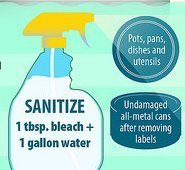
·         Thoroughly wash metal pans, ceramic dishes, utensils (including can openers) with soap and water (hot water if available). Rinse and sanitize them by boiling in clean water or immersing them for 15 minutes in a solution of 1 tablespoon of unscented, liquid chlorine bleach per gallon of drinking water.
·         Thoroughly wash countertops with soap and water (hot water if available). Rinse and then sanitize them by applying a solution of 1 tablespoon of unscented, liquid chlorine bleach per gallon of drinking water. Allow it to air-dry.
·         Note: If your entire refrigerator or freezer was in flood waters — even partially — it is unsafe to use and must be discarded.
After a Weather Emergency
The USDA also issued a news release with food safety tips to follow in advance of losing power, steps to follow if the power goes out,  and food safety after a flood. There were also steps to follow after a weather emergency.
·         Check the temperature inside of your refrigerator and freezer. Discard any perishable food (such as meat, poultry, seafood, eggs or leftovers) that has been above 40°F for two hours or more.       
·         Check frozen food for ice crystals. The food in your freezer that partially or completely thawed may be safely refrozen if it still contains ice crystals or is 40°F or below.
·         Never taste food to decide if it is safe.
·         When in doubt, throw it out. 

For more information about cleaning up after a disaster, review Prepareathon’s Flood and Hurricane guides. Also, see food safety tips at Ready.gov.

Sunday, September 16, 2018

Family Emergency Communication Plan

When a disaster strikes, it is too late to develop a family emergency plan.  Here is some advice from FEMA on how to do so.  There are three steps: Collect, share and practice.
Collect:  This refers to gathering the necessary information to implement your plan.  It also includes writing this down.  Information needed includes household information, school caregiver and childcare information, out of town contact, emergency meeting places (more than one including by home, and out of town, and any other important information.
Share: means to share your written copy with all involved, your family members and those who are your contacts.
Practice: Putting your plan into action before time will make sure it will work in an emergency.  Remember texting is best because it requires less band width.  It will also be important to conserve phone energy.  Best to keep phones fully charged, and consider solar power for recharging in an emergency.

Friday, September 8, 2017

Earthquake Preparedness from FEMA

Lots of disasters happening these days from earthquakes, to hurricanes to fires.  It is important to be prepared.  Here is a flyer to help with that.  This brochure suggest three steps: Prepare, Survive and Recover for before during and after an earthquake.  Lots of good advice.
 https://www.fema.gov/media-library-data/1408632135401-3d0521fa59d0dd4016e82f08fe7f3732/PrepareAthon_EARTHQUAKES_HTG_FINAL_508.pdf

Sunday, August 6, 2017

National Preparedness Month is September

The theme for national Preparedness Month is "Disasters Don't Plan Ahead, You Can."  By going to the link above you can access information on planning ahead.  This website is from FEMA.  It includes how to make a disaster plan.  It suggests practicing, even with you animals, driving them in the vehicle, so they won't be so scared in an emergency.

Saturday, August 5, 2017

FEMA Guidelines for the Upcoming Solar Eclipse

Prepare for the Solar Eclipse

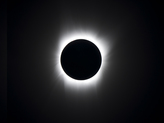
Solar EclipseOn August 21, the United States will be experiencing the first total solar eclipse since 1991 and the first to move across the entire mainland of the country since 1918.

A solar eclipse happens when the moon passes in between the earth and the sun. While this rare occurrence may be exciting, safety is a concern. Looking directly at the sun during an eclipse could severely hurt your eyes. 

Protect your eyes and view the eclipse safely with these tips from theNational Weather Service:
·         Make sure to wear special solar filtered sunglasses if you plan to stare directly at the eclipse.
·         It is only safe to stare at the sun during the eclipse when the moon is totally covering the sun. This only happens for a brief period and will only occur in a very narrow path about 70 miles wide from Oregon to South Carolina.
·         You can also safely view the eclipse through a solar filtered telescope or Welder’s glass #14 and darker.
·         If you are going camping to view the eclipse, visit the U.S. Forest Service website for safety tips. Also, check www.weather.gov  for signs of low humidity and high temperatures, which are a recipe for wildfires.

For more information on the solar eclipse or for a solar eclipse party kit, visiteclipse2017.nasa.gov/safety

Sunday, July 23, 2017

Emergency Financial First Aid Kit

FEMA instructions with regards to what paper work you need to have on hand in case of an emergency.  This includes a checklist; and describes four areas of papers needed.
Identification includes personal identification as well as that of children and pets.
Financial Information including tax returns and house payments and sources of income.
Medical information which should include lis of medications, insurance information and physician information.
Lastly Household contacts which should including banking and insurance agents as well as other service providers.   It can also include emergency contacts.