Health Is Vital

Health is taken for granted, until you can't any more. In this blog I hope to put down on paper some of the articles I come across and want to remember, about health. I will be personalizing these articles to apply to me. I am diabetic, over weight, have high blood pressure and tinnitus, so these are the things you will find here. I will include nutrition, exercise, and holistic health, and many other ideas. I work in the health profession, particularly mental health, and have an interest in suicide prevention; so these topics will also be covered in this blog. Please, if you are suffering reach out. Our county health and crisis line is 1-855-278-4204.
Showing posts with label Santa Clara County Mental Health. Show all posts

Sunday, January 20, 2019

Crisis Text Services in Santa Clara County

Crisis services are now available via text messaging in Santa Clara County.  
About half of adults will experience a mental health challenge over the course of their lifetime, according to the Centers for Disease Control and Prevention. Now, emotionally or mentally distressed residents in Santa Clara County have access to free, text-based, confidential assistance from trained Crisis Text Line counselors by texting “RENEW” to 741741. The support is free, accessible 24/7, and confidential. Learn more at www.sccbhsd.org/suicideprevention
To date, Crisis Text Line, a national organization, has answered more than 84 million messages. The organization has more than 4,500 active Crisis Counselors with strict safeguards and protocols to provide care, safety, and confidentiality for each user. “The ability to offer text-based support to people in need adds a new dimension to our outreach services, and is an especially important tool to offer to young people in Santa Clara County,” said Toni Tullys, Director of the County of Santa Clara Behavioral Health Services Department, adding, “It’s important to make access to counseling easy and approachable, and text-based support does both.”

The vast majority of Crisis Text Line users are under age 25; partnering with Crisis Text Line is an important part of our work to address the issue of youth suicides – including college-age youth.” The County’s Behavioral Health Services Department already offers a 24/7, free, confidential Suicide and Crisis Hotline at 1 (855) 278-4204​​, mental health services information and referrals at 1 (800) 704-0900, and substance abuse services information and referrals at 1 (800) 488-9919.

Saturday, January 7, 2017

Intensive Case Management Services for the Severely Mentally Ill

This is the summary of a comparative research conducted in Santa Clara County. I don't see any dates on this but the results were released in 1993.

A Comparative Evaluation of Three Intensive Case Management Services for the Severely Mentally Ill:
Jeanette M. Jerrell, Ph.D., Director of Research
Rex S. Green, Ph.D. Evaluation Research Specialist
Santa Clara County Mental Health Services Research Center
Santa Clara County Mental Health Bureau
Bob Martinez, Director

Summary: It is certain that severely mentally ill adults with high levels of need for services can be managed and treated most effectively using intensive case management programs.  These programs clearly reduce the total direct care costs for clients over time and improve client functioning in the community as well.  These findings indicate that expansion of these case management services will result in substantial savings to the County mental health system while improving client outcome.

The Mental Health Bureau has been evaluating the relative cost-effectiveness of three of its intensive case management programs which specifically target their services to adults who are severely and persistently mentally ill and are high users of the acute and subacute treatment services.  These clients have two or more inpatient or skilled nursing facility episodes during the year prior to their entry into one of these three case management programs, as well as being noncompliant with previous outpatient services, being conserved and receiving SSI payments.  the three case management programs are: Virginia Street Project, Community Companions, and Downtown Mental Health Center.  Each program offers clients a different mix of outpatient, medication, case management, housing, and supportive day services, depending on their service philosophy and their caseload size.

Overall, the three intensive case management programs currently serving severely and persistently mentally ill adults are substantially reducing the direct service costs for these clients and improving their psychosocial functioning in the majority of clients served.  Our data also indicate that these reductions in direct mental health service costs do not increase the burden on families or other social/criminal justice services.  However, there are differences among the three programs in the degree to which they are lowering direct service costs and increasing client functioning.  The relative cost-effectiveness of the three programs depends on which outcome (treatment cost reductions versus client improvement) is considered.

The most cost-effective service from both of these perspectives is the Virginia Street Project which is reducing the total cost of mental health services to its clients by about $14,000 per year, compared to the level of care they required prior to receiving this service.  the greatest reduction is in the inpatient days and skilled nursing facility days of service used (see Figure 1).

They are also providing significantly more supportive outpatient and case management services to these clients (see Figure 2), but these services are offered at only a fraction of the cost of acute and subacute treatment facility costs.  Client functioning is improving to the greatest extent among VSP clients as well (see Figure 3).

Clients served by Community Companions demonstrate the next greatest improvement (see Figure 3) in functioning, and their total treatment costs are reduced $5,000 per client per year, the first year they are provided intensive case management services.  This outcome seems consonant with Companion's program philosophy which emphasizes client empowerment and rehabilitation as well as compliance with taking medications and explicit avoidance of hospitalization.

Downtown Mental Health Center clients showed reduced annual direct treatment costs of about $7,800, per client per year.  Client functioning improved less in the first year than for the other two programs, although Downtown MHC clients demonstrated the same pattern of overall change as the clients in VSP or Companions (Figure 3).  These outcomes seem consistent with the program's emphasis on maintaining clients in the community by providing supportive outpatient counseling and medications and with staff caseloads being twice the size of those at VSP or Community Companions during this study.


Friday, February 26, 2016

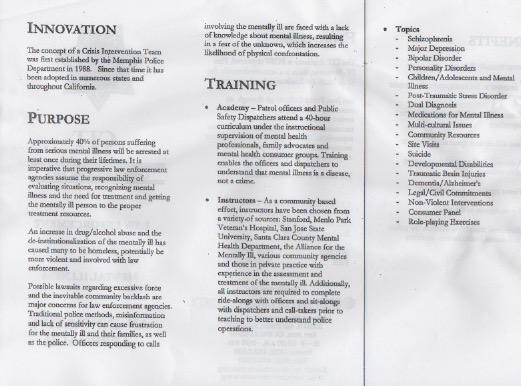
**Crisis Intervention Team

Mental Health in the county where I work has done some innovative things for mental health/ police officer cooperation.  One of those things is the mental health department provides training for police officers who want to become certified as Crisis Intervention Team officers.  At this time there is not an active mobile mental health team for adults, and consequently the police are called upon to do mental health interventions.  However the crisis intervention team officers are provider an intensive training to help them with mental health consumers.  This started with San Jose Police Department, but has now spread to all of the police department through out the county.


Wednesday, January 20, 2016

Booklet Review: Be True and Be You: A Basic Mental Health Guide for LGBTQ Teens

This is a booklet sponsored by Each Mind Matters, a California Mental Health Movement.  IS has some very good information about coping with mental illness.
It reveals some mental health myths: "People with mental illnesses are just weak and need to 'snap out of it.'"  Mental illnesses are illnesses just like any other illness.  They are caused by a mix of what is going inside your body and your environment.  Myth: "If you have a mental illness you will never get better." People can get better from mental illness.  Of course all illnesses are different and there are different types of recovery.  However people with mental illness can live healthy, happy lives.  Myth: "I can't help someone with mental illness.  Only a doctor can." Although only a doctor of professional can diagnose mental illness, we all can help.  Much of this is based on our attitude.  Be willing to talk to people with mental illness and find out about their interests and talents.  If we hear derogatory terms like "crazy" os "psycho" we can speak up.  We can help those who are bullied because of mental illness.  Myth: "People diagnosed with mental illnesses are dangerous or violent."  Most people with mental illness are not violent or dangerous.  However their risk of being the victim of violence often goes up.  Please speak up if others are being bullied or hurt.  Myth: "People who are not straight have a mental illness."  Being LGBRQ is not a mental illness.  However LGBTQ often may be at higher risk for mental illness due to environmental interaction.
There is also a very good section in this booklet on ways to deal.  We are all stressed, and sometimes want to get away.  Poor ways of dealing with this include drugs or alcohol, self-harm and risky sexual behavior.  Some alternative "Ways to Deal" are: Express yourself.  Find a way to express your thoughts and feelings.  This could be having a good cry, talking to a friend, or through creativity--art, music, cooking, dancing, etc.  Find support.  Opening up to a trusted friend, parent, counsellor are ways of finding support.  There are also talk lines: Santa Clara County 1-855-278-4202, Boys Town 1-800-448-3000.  Challenge negative talk.  If self-talk, or talk from others is making it more difficult to find your goals, then we should dump it.  Instead we may choose to focus on positive and more realistic self talk that can help you succeed.  Take care of your body.  Regular exercise, eight hours of sleep nightly and good nutrition can work wonders for your mood.  Get Involved.  Find things you enjoy and be involved.  Serving others is a great way to promote your own mental health.  Know where to get help.  Everyone has the right to feel safe.  It can be helpful to talk with an adult or a friend.  However sometimes professional help is needed.  Santa Clara County Mental Health is 1-800-704-0900.

Sunday, May 31, 2015

**Documentary Review: In Our Community: Mental Illness: Diana Guido

In Our Community.  It is so difficult to lay your life open, but in this case Ms. Diana Guido does this and does it very well.  She is a peer support, substance abuse counselor for Santa Clara County.  She gives a very good over view of mental health services.  This includes a discussion of the WRAP course.  Wellness Recovery Action Plan is an evidence based peer support service in which attendees develop their person plan for wellness.  She also talks of being a Mental Health First Aider. This also is a national training to help encourage people to look out for each other.  She also educates people to the county's crisis and warm line, 1-855-278-4204.

Monday, May 11, 2015

**May is Mental Health Month: Santa Clara County

Join the Mental Health Matters Month Celebration!
The Behavioral Health Services Department and its prevention and early intervention programs
invite you to a celebration of hope, wellness and recovery. If you are interested in attending during
work hours, you must have prior approval from your supervisor. The celebration will be held May 27
from 12:00 pm – 3:00 pm at the Learning Partnership, 1075 E. Santa Clara St, San Jose. There will
be music, program information, resources, giveaways, wellness booths, and cultural ceremonies. 
The first 50 to attend will receive a free Each Mind Matters t-shirt.  You can also participate by taking
an online course on suicide prevention or attend a Mental Health First Aid Training. For more information,

Tuesday, October 14, 2014

Sunday, May 18, 2014

__May is Mental Health Month, Infomail Message

Please post and distribute                                                                                                                                                                                                                                                                               May 15, 2014
 
Message from René G. Santiago
Sixty-five years ago, May was designated as Mental Health Month to raise awareness about mental illnesses and the importance of mental wellness for all.  Did you know that nearly 1-in-5 Americans over the age of 18 will experience a diagnosable mental health disorder in a given year? Nearly half of them will experience a mental health disorder in their lifetime. Another important fact: more people die from suicide than from homicide in Santa Clara County. In 2013, there were 149 suicides and 56 homicides in Santa Clara County. The people who died from suicide came from every city in our county, all income levels, and a variety of ethnic and cultural backgrounds. The ages of people who died from suicide ranged from 15 years old to 93 years old. Every death is tragic, but we know when it comes to suicide, these deaths are preventable.
 
From research and from experience, it is clear that mental health is integral to a person’s overall health and that there is “no health without mental health.”  With effective services and treatment, individuals with mental health conditions can recover and lead full, productive lives. The Santa Clara Valley Health & Hospital System (SCVHHS) is working to integrate prevention and treatment approaches across the Mental Health Department, Department of Alcohol & Drug Services (DADS) and Santa Clara Valley Medical Center.  Through our services, we help those struggling with mental health disorders and addictions get the care they need in safe and stable environments.  By treating the physical and behavioral health needs of our patients and clients, we can improve the individual’s overall health.

In raising awareness, we need to let people know they are not alone. In the United States, it is estimated that 4 in every 10 cases of disability are directly attributed to mental disorders like major depression, bipolar disorder, schizophrenia, and obsessive-compulsive disorder. It is also estimated that twice as many women (12 percent) as men (6.6 percent) are affected by a depressive disorder.

If we really want to improve the health of our community and help our residents live well, we must continue to address mental health and addiction disorders, as well as enhance the services we provide. By having the Mental Health Department and DADS come together as a new Behavioral Health Services Department, we can be more effective in providing services and be better positioned as the provider of choice for these services.

Providing for the continuum of care is essential to helping people realize their road to recovery. The establishment of the Behavioral Health Services Department is one of the ways we will realize our SCVHHS vision of Better Health for All.

Tuesday, May 13, 2014

**Book Review: Youth Mental Health First Aid USA for Adults Assisting Young People


C 2012 Maryland Department of Health and Mental Hygiene, Missouri Department of Mental Health and National Council for Community Behavioral Healthcare.
This book was given to me as part of a training presentation by the same name.  This training is geared towards nonprofessional people, and provides assistance so they can offer help to their family members, friends, community members or others.  It compares this program to first Aid for a physical problem.  First Aid aims to preserve life, prevent further harm, promote recovery and resiliency and provide comfort.  Mental Health First Aid is geared to promote life when a person may be a danger to themselves or others, prevent the problem from becoming worse, promote recovery, provide comfort and support and help to identify or guide a person to appropriate resources and supports.  It does this through the “Youth Mental Health first Aid Action Plan.”  This plan includes five steps which spell out ALGEE.  1) Assess for risk of suicide or harm; 2) Listen nonjudgmentally; 3) Give reassurance and information; 4) Encourage appropriate professional help; 5) Encourage self-help and other support strategies. 
It includes a section on adolescence and young adulthood, and distinguishing these transitional steps which are part of normal development from mental health issues.  It then has a very large section on different mental health issues, and how to apply this model.  These include: depression, anxiety, eating disorders, psychosis, substance use and attention and disruptive behavior problems. 
It concludes with a how-to handle certain situations.  This includes suicidal thoughts, self injury, panic attacks, trauma, acute psychosis, aggressive behavior and emergencies from alcohol or drug abuse.
This workbook is a tremendous resource.  However, I would advise taking the course so as to have some practice in the techniques before trying them.

Saturday, May 10, 2014

**Hands Only CPR, AED and CPR

I was introduced to a three important things at a training I am doing for employment for the Emergency Response Team at work.  First is the importance of getting someone to Automated External Defibrillator as quickly as possible.  If someone who has gone into cardiac arrest receives this shock within five minutes, their chance of survival is over 80 percent.  That is pretty good odds.  The odds go down over time, but are still pretty high even after five minutes.
The second thing I learned is Hands only CPR.  There are only two steps in this CPR, 1. call 911 and start chest compressions.  The beat of "Staying Alive" is the perfect rhythm.
The third thing learned is that even in regular CPR, the first step is now chest compressions rather than airway and breathing.  You ask someone to call 9-11 or do so yourself, then the order is now chest compressions, airway and then breath.  For an adult it is 30 chest compressions, then open the airway, quick check for breathing, then two breaths, followed by 30 chest compressions.  This change was made in 2010.  After doing this five times, then you check for signs of life, and then continue until relieved by trained medical personnel, or you can't anymore due to exhaustion.  You should not do breathing if you do not have a shield between yourself and the person who has passed out.  In this case, Hands only CPR is preferred.
http://www.heart.org/HEARTORG/CPRAndECC/HandsOnlyCPR/Hands-Only-CPR_UCM_440559_SubHomePage.jsp


Wednesday, May 7, 2014

**What Would You Do if You Knew that I Want to Commit Suicide


This is the front, and an inside page to this pamphlet in Spanish. What would you do if you knew I was thinking of suicide?  This pamphlet answers this question with three answers.
1) First recognize the signs.  The pamphlet explains that recognizing signs of suicide can be difficult.  If you have a sense something is wrong, go with your feelings.
This our clues to look for:
Talking about suicide or wanting to die
Feeling without hope, desperate or trapped
Giving away possessions
Rage or anger
Increase in consumption of alcohol or drugs
Distancing self from others
Feeling anxious or agitated
Change in sleep pattern
Sudden changes in humor
Feeling useless

2)  Second is to communicate, to talk; to ask "Are you thinking of suicide"  This pamphlet suggests starting the conversation.  Mention the things you have observed, the things that are worrying you.  Ask are you thinking of suicide, listen.

3) Look for help.  This pamphlet suggests
911 for emergency situations,
  for advice and direction
http://elsuicidioesprevenible.org/
The national hotline is

1 (800) 273 8255

Wednesday, April 30, 2014

**Suicide is Preventable

http://www.suicideispreventable.org/


Each Circle adds something you might watch out for: Increased alcohol or drug use, Reckless behavior; Anxiety or agitation; Changes in sleep' Withdrawal; Anger; Sudden mood changes; Talking about wanting to die or suicide; Putting affairs in order; Feeling Hopeless, helpless, desperate; no sense of purpose; Giving away possessions.  The number given is the national suicide line.  The line for Santa Clara County is 1-855-278-4204.   
Prior crisis line numbers are old.  The number is now 988 text or call.

Monday, April 28, 2014

**Documentary:The Bridge (Suicide) and My Thoughts

https://www.youtube.com/watch?v=vhARXu3wWDc
This is a documentary that was presented on HBO.  It was a bit difficult to watch. I had to do it in several parts.  If this subject is a problem for someone, it would be best they not watch.  The Bridge is a 2006 documentary film by Eric Steel that tells the stories of a handful of few individuals who committed suicide at the Golden Gate Bridge in 2004.  They had two cameras filming the bridge  during daylight hours.
This movie was introduced to me at a training I attended this week at work dealing with "Mental Health First Aid."  In the training the presented just one story, of the individual who jumped and survived.  They trainers were making the point that perhaps if someone how, there were times when, if a mental health first aid intervention had been offered, the individual may not have jumped. 
This movie is very impactful.  I don't know how many suicides were taped in the making of this film, but there were several, and many were shown.  The movie becomes more personal as they talk to survivors of suicide, and then show the suicide.  There is one case where someone is able to pull someone back over the railing.
The movie contends that more suicides have taken place here than any other place in the world. 
I was impressed with the showing, and telling of the stories of people in pain.  Some suffered from depression, or other mental illnesses.  Some were homeless, some with substance issues.  There abuse were 24 suicides in 2004 off the bridge.  There were those with relationship issues, and those with loss issues.  It helped me as a mental health worker to step back, and see people as individuals in pain, rather than just callers, or clients. 
Before leaving this some words of advice from someone who has manned the suicide and crisis line, and after-hours line for most of my professional career, 30 years now.  Do not be afraid to ask someone if they are contemplating suicide.  Don't no be afraid to ask, because the asking might save someone's life.  But also be prepared to give some assitance if the answer is "yes." You can refer to a crisis line:
National Suicide Prevention Lifeline 1-800-273-talk
Santa Clara County Suicide Line  1-855-278-4204
You can explore self-help resources: a friend, a parent, a church leader, a coach whoever.
However: always take it seriously.  Do not minimize how someone else feels.  People hurt, and need support sometimes to make it through a rough period.  Professional help is available: 911, nearest emergency room, county mental health Santa Clara County 1-800-704-0500.
If you would have trouble seeing someone jump to their death, do not watch this movie.  It shows several jumpers, and follows some as they fall.