Health Is Vital

Health is taken for granted, until you can't any more. In this blog I hope to put down on paper some of the articles I come across and want to remember, about health. I will be personalizing these articles to apply to me. I am diabetic, over weight, have high blood pressure and tinnitus, so these are the things you will find here. I will include nutrition, exercise, and holistic health, and many other ideas. I work in the health profession, particularly mental health, and have an interest in suicide prevention; so these topics will also be covered in this blog. Please, if you are suffering reach out. Our county health and crisis line is 1-855-278-4204.
Showing posts with label Santa Clara County Behavioral Health. Show all posts

Monday, May 11, 2020

Suicidal Thoughts? Let's talk about it.


This is a small document from Santa Clara County Behavioral Health Services.  It promotes calling the suicide and crisis line to deal with trouble coping with change, chronic back pain, thinking live is not worth it, feeling isolated, feeling you are a burden to others, feeling abandoned or betrayed, feeling ashamed, having no purpose, having sudden mood changes, giving away possessions, doing careless things, increase in alco or drug usage, withdrawing, financial stress, chronic illness, death or suicide of a loved one, conflict with family, other don't understand you,
Please, if you need to talk, they are there 24 hours.
National suicide prevention line serving the Kingman area.  (800) 273-8255

Crisis Intervention ServiceSuicide Prevention Service

Wednesday, April 11, 2018

Reflective Leadership: Reflective Supervision

Attended this training while I was doing the supervision curriculum.  It was presented by Maretta Juarez.  Just a few ideas I gleaned from the training.  "We do not learn from experience...we learn from reflecting on experiences" John Dewey.
Reflection is:
Stepping back from the immediate, intense experience to think about what it really means.
Examining our thoughts and feelings about experiences. 
Important skills include self awareness, careful observation and flexible responses.  Elements of reflective practice are relationships and development, parallel thinking, awareness, perspective taking, not knowing and collaborative stance.
Intended impact of reflective practice are: improved outcomes, improved program quality, improved clinical practice, and reflective practice and activities.

Sunday, December 3, 2017

Statewide Medical and Health Exercise: Disaster Preparedness Drill

There were disaster preparedness drills held though out the state a couple weeks ago.  Each county devised their own scenario, but the theme was terrorist attack.  I was invited to participate in the drill for Santa Clara County, representing behavioral health.  We were on the third floor of the Sheriff's office where the have the Emergency Command Center.  There was a table in the middle for the command captain and his immediate team.  Then beyond that were other important players, including behavioral health, animal control, public health, medical examiners office etc.  They have a system set up where in real time a worker was monitoring the ambulances and available space of all the hospitals.  In this way they knew which hospital could take someone, and where their were ambulances available to get them there.  It was quite a system. 

Sunday, August 20, 2017

The Eclipse Is Here: Save Energy

Never stopped to think about the effect the eclipse could have on solar energy.  Her our some ideas from our boss at work:

Dear County Employees,

On August 21st, the first total solar eclipse visible in the contiguous United States since 1979 will temporarily darken skies across the country. In California, the eclipse will impact energy supply by reducing solar energy supplies for more than two hours, and the California Public Utilities Commission (CPUC) is asking for our help.

Government buildings and other facilities are significant users of electricity. With that in mind, the CPUC is requesting local governments across California to join the State Government in drastically reducing its power consumption between 9 a.m. and 11: 30 a.m. on Monday, August 21st. The less energy those facilities consume, the less additional unclean power needs to be generated. As less sunlight falls onto the Golden State, one of our greatest sources of “clean” power [solar] will see its output fall significantly.

The good news is that our Facilities teams here at the County have already been doing projects to reduce energy consumption at our buildings through lighting retrofits, recommissioning heating and air conditioning, and general ongoing maintenance.  Nonetheless, they may raise temperature set points a little and reduce lighting where there is little or no impact to operations or services.

Additionally, to reduce the anticipated additional demands on the electric grid, we are asking employees to help shave energy use in our County facilities on August 21st, between 9 – 11:30 a.m.

The following are actions you can take to shave energy while at work:
  1. Use and operate your laptops on battery
  2. Do not charge any electronics during the eclipse
  3. Turn off desktop CPUs and monitors when not in use
  4. Turn off unnecessary lighting in your work area
  5. Unplug appliances vampire loads such as TV monitors, electronic chargers, etc.
  6. Avoid running toasters, microwaves, etc.
  7. Also make sure you are as unplugged as possible at your home even if you are at work.
Thank you for your continued commitment to our environment and consideration to take part in this effort. We encourage you to take the pledge now at CALECLIPSE.ORG .

Jeffrey V. Smith M.D., J.D.
County Executive

Monday, August 7, 2017

Human Trafficking Resources

Human Trafficking 

Community Solutions’ program for Survivors of Human Trafficking provides counseling, therapy, advocacy, and case management services to assist adult or child survivors of human trafficking in regaining strength, hope, and control in their lives.  

We also provide counseling, therapy, advocacy, and case management services to Commercially Sexually Exploited Children (CSEC). Commercial sexual exploitation includes the prostitution, child pornography, and other forms of transactional sex where a child engages in sexual activities to have key needs fulfilled, such as food, shelter or access to education.

Referrals for these programs can be made through agency referrals, walk-ins, or via telephone. Walk-ins are accepted daily at the Gilroy and Morgan Hill offices. Services are available in English or Spanish. There are no fees for this program. 

24-Hour Domestic Violence & Sexual Assault Crisis Line
(South Santa Clara County & San Benito County)
1.877.END. SADV
(1.877.363.7238)

This link is to a documentary review on human trafficking of children, I Am Jane Doe

Saturday, January 14, 2017

Sunday, December 25, 2016

Mental Health Advocacy Project: Santa Clara County

The mission of the Mental Health Advocacy Project (MHAP) is to empower people identified as having mental or developmental disabilities to live more independent, secure and satisfying lives through the enforcement of their legal rights and the advancement of their social and economic well-being.  They now service of 5,000 client annually.  The provide legal services for economic rights, housing rights and patients' rights.  They also provide outreach and education as well as technical assistance to mental health, social service and housing programs.  They can be accessed at 1-800-248-MHAP or 408-280-2420.

Friday, December 9, 2016

Family and Children Services: Deaf and Hard of Hearing Program

In Santa Clara County, the primary provider of mental health services to the deaf and hard of hearing community is family and Children Services of Silicon valley.  Their primary location is on Julian Street, just off of the Alameda.  The communicate with the deaf community through video phone and email.  They have counseling, case management and mental health services for deaf individuals, support for their families, offer ASL classes, provide education to the community and are knowledgeable about resources for the deaf community.


Tuesday, November 1, 2016

Our New Brand at Work

As part of moving from Mental Health Services to Behavioral Health Services (combining with Drug and Alcohol Services) is making a new brand.  This has included redoing our traditional logo.  These gifts were waiting for us one day.  Everyone in Behavioral health received the same.


Sunday, August 7, 2016

Medications for Mental Health

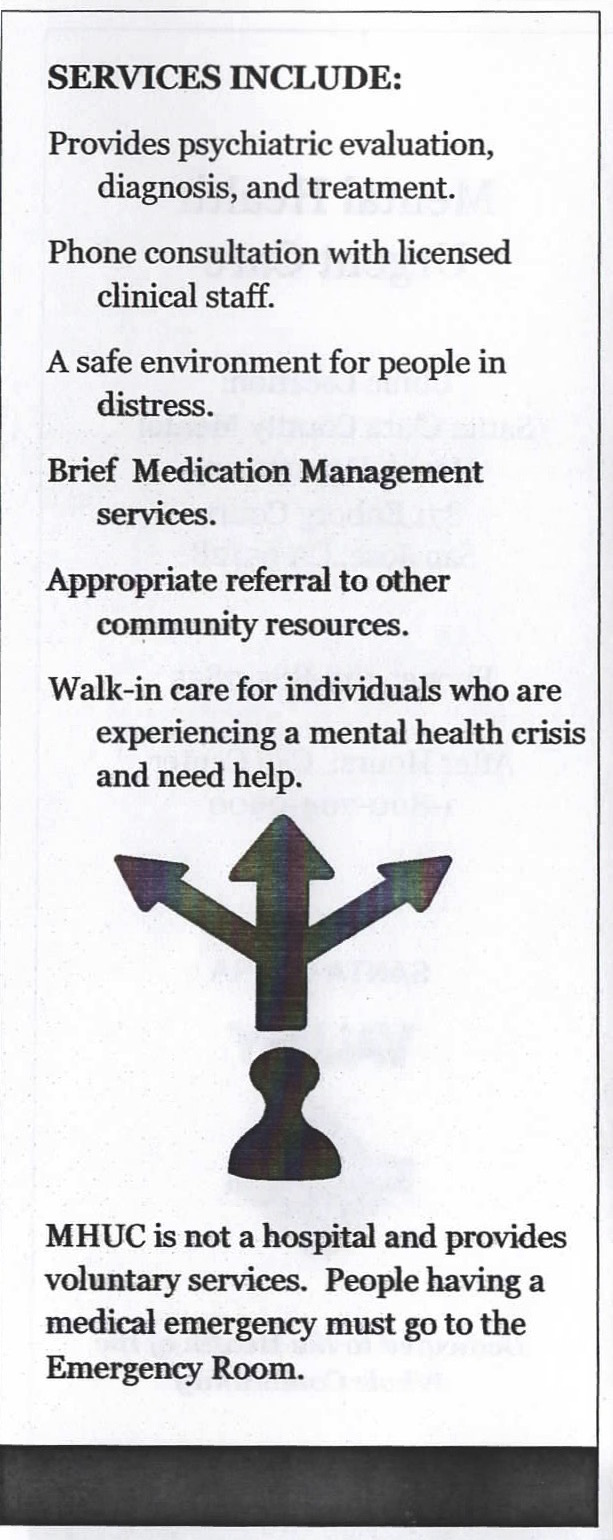
Medications are such an integral part of treatment for mental illness.  This brochure gives a brief overview.  Of course information is given about specific medication when is is prescribed.


Each category includes specific medications.  Of course each medication comes with benefits.  Medications are taken to reduce symptoms, prevent relapse and improve quality of life.  Successful medication treatment requires taking them as prescribed, take them at the same time each day, do not change you dose, follow instructions with regards to take with food or not, do not stop taking or reduce the dose without talking to your doctor.  Report to your doctor and allergies you may have, if you are taking other drugs , including street drugs, are pregnant or breast-feeding, have diabetes, kidney liver or heart disease, are on a special diet, drink alcohol or smoke, experience side effects.


Sunday, July 31, 2016

Booklet Review: Information Booklet for Families in Crisis

This is a good little booklet for families who might have a family member in need of psychiatric hospitalization.  It explains the process of being put on a hold including 5150 (72-hour hold).  This means a psychiatric placement for up to 72 hours, but not often that long, 5250 or 14-day certification for Intensive Treatment.  EPS is the program in Santa Clara County where most individuals on a hold go, until they are either able to go home, or certified for longer placement.  CIT (Crisis Intervention Team) is the program with police officers in Santa Clara who are trained to deal with mental health emergencies.  Family members are allowed to provide information to psychiatric providers, or CIT officers.  This information should be accurate.  Common terms are Danger to Others (threatening to hurt others), Danger to Self (threatening to hurt oneself), Gravely Disabled (so ill the individual cannot take care of his/herself).

This booklet is put out by Santa Clara County Behavioral Health