http://www.msn.com/en-us/money/retirement/20-free-ways-to-stay-busy-after-retirement/ss-BBQpVRs?ocid=ientp
Take a Hike
Join a Book Club
Catch up on Podcasts
Take up Cooking
Donate your Time
Become you Family's Archivist
Make a new Friend
Start Exercising
TED Talks
Soak up some Culture
Just Breath
Connect with Grandkids
Join the Peace Corps
Foster a Pet
Sing your Life
Be a Mentor
Open an Etsy Shop
Write Letters
Pen a Novel
Get Involved
Sunday, January 20, 2019

Crisis Text Services in Santa Clara County
Crisis services are now available via text messaging in Santa Clara County.
About half of adults will experience a mental health challenge over the course of their lifetime, according to the Centers for Disease Control and Prevention. Now, emotionally or mentally distressed residents in Santa Clara County have access to free, text-based, confidential assistance from trained Crisis Text Line counselors by texting “RENEW” to 741741. The support is free, accessible 24/7, and confidential. Learn more at www.sccbhsd.org/suicideprevention
To date, Crisis Text Line, a national organization, has answered more than 84 million messages. The organization has more than 4,500 active Crisis Counselors with strict safeguards and protocols to provide care, safety, and confidentiality for each user. “The ability to offer text-based support to people in need adds a new dimension to our outreach services, and is an especially important tool to offer to young people in Santa Clara County,” said Toni Tullys, Director of the County of Santa Clara Behavioral Health Services Department, adding, “It’s important to make access to counseling easy and approachable, and text-based support does both.”
The vast majority of Crisis Text Line users are under age 25; partnering with Crisis Text Line is an important part of our work to address the issue of youth suicides – including college-age youth.” The County’s Behavioral Health Services Department already offers a 24/7, free, confidential Suicide and Crisis Hotline at 1 (855) 278-4204, mental health services information and referrals at 1 (800) 704-0900, and substance abuse services information and referrals at 1 (800) 488-9919.
Wednesday, September 19, 2018
In the Kitchen After a Flood
Food Safety and Kitchen Cleaning After a Disaster
 Flooding can cause power outages for hours, days and even weeks, which may make food unsafe to eat. Flooding can cause power outages for hours, days and even weeks, which may make food unsafe to eat.
If a fire, flood, power outage or natural disaster impacts your home, minimize the potential loss of food and reduce the risk of foodborne illness by knowing how to determine food safety.
You can learn the right decisions for keeping your family safe after a power outage with food and cleaning safety facts from the United States Department of Agriculture (USDA).
After a Flood
· Use bottled drinking water that has not come into contact with flood water.
· Do not eat any food that may have come in contact with flood water.
· Discard any food that is not in a waterproof container if there is any chance it may have come in contact with flood water. Food containers that are not waterproof include those with screw-caps, snap lids, pull tops, and crimped caps.
· Discard cardboard juice/milk/baby formula boxes and home canned foods if they have come in contact with flood waters. They cannot be cleaned and sanitized effectively.
· Inspect canned foods; discard any food in damaged cans. Check cans for swelling, leakage, punctures, holes, fractures, extensive deep rusting, or crushing/denting severe enough to prevent normal stacking or opening with a manual, wheel-type can opener.
· Discard wooden cutting boards, plastic utensils, baby bottle nipples, and pacifiers that may have come in contact with flood waters. There is no way to clean them safely.
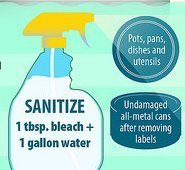
· Thoroughly wash metal pans, ceramic dishes, utensils (including can openers) with soap and water (hot water if available). Rinse and sanitize them by boiling in clean water or immersing them for 15 minutes in a solution of 1 tablespoon of unscented, liquid chlorine bleach per gallon of drinking water.
· Thoroughly wash countertops with soap and water (hot water if available). Rinse and then sanitize them by applying a solution of 1 tablespoon of unscented, liquid chlorine bleach per gallon of drinking water. Allow it to air-dry.
· Note: If your entire refrigerator or freezer was in flood waters — even partially — it is unsafe to use and must be discarded.
After a Weather Emergency
The USDA also issued a news release with food safety tips to follow in advance of losing power, steps to follow if the power goes out, and food safety after a flood. There were also steps to follow after a weather emergency.
· Check the temperature inside of your refrigerator and freezer. Discard any perishable food (such as meat, poultry, seafood, eggs or leftovers) that has been above 40°F for two hours or more.
· Check frozen food for ice crystals. The food in your freezer that partially or completely thawed may be safely refrozen if it still contains ice crystals or is 40°F or below.
· Never taste food to decide if it is safe.
· When in doubt, throw it out.
|
Sunday, September 16, 2018
Family Emergency Communication Plan
When a disaster strikes, it is too late to develop a family emergency plan. Here is some advice from FEMA on how to do so. There are three steps: Collect, share and practice.
Collect: This refers to gathering the necessary information to implement your plan. It also includes writing this down. Information needed includes household information, school caregiver and childcare information, out of town contact, emergency meeting places (more than one including by home, and out of town, and any other important information.
Share: means to share your written copy with all involved, your family members and those who are your contacts.
Practice: Putting your plan into action before time will make sure it will work in an emergency. Remember texting is best because it requires less band width. It will also be important to conserve phone energy. Best to keep phones fully charged, and consider solar power for recharging in an emergency.
Collect: This refers to gathering the necessary information to implement your plan. It also includes writing this down. Information needed includes household information, school caregiver and childcare information, out of town contact, emergency meeting places (more than one including by home, and out of town, and any other important information.
Share: means to share your written copy with all involved, your family members and those who are your contacts.
Practice: Putting your plan into action before time will make sure it will work in an emergency. Remember texting is best because it requires less band width. It will also be important to conserve phone energy. Best to keep phones fully charged, and consider solar power for recharging in an emergency.
Saturday, September 15, 2018
How to Lose Belly Fat
I saw the title to this article in Everyday Health and was really excited. This is one of my goals. However I was a bit disappointed in the suggestions. The article is about exercises to lose belly fat. It suggests the best involve weights--High-Intensity Strength Training. Studies show strength training targets belly fat better than cardio. One of the exercises is the incline push-up. This is something I can do, and there are chances to do this many times a day. The other exercises seem too complicated and I can't really see them in my brain. I need a video or someone to guide me I guess.
Thursday, August 30, 2018
Friday is International Overdose Awareness Day.
This flyer has introduced me to Naloxone, a medication that can counteract the effects of opioid drug overdose. Too late for the display at Farmer's Market, but not too late to remember the Overdoe Awareness Day.


VMC Farmers Market
751 Bascom Ave, San Jose, CA
Wednesday, August 29, 10AM to 2PM
International
Overdose
Awareness Day
August 31 is International Overdose Awareness Day.
Everyday, we see lives around us being changed and lost to
overdose. Overdose does not discriminate – it could be you or
someone you love, a friend, colleague or your neighbor.
Come join us to understand how this affects each one of us.
We will be providing educational resources and distributing
Naloxone, the life-saving opioid overdose medication.
To†join†our†coalition¨†receive†opioid†education†or†host†a†free
Naloxone†training¨†contact†sccoopp@hssÆsccgovÆorg
Find†us†online†at
https∫ØØwwwÆsccgovÆorgØsitesØbhdØinfoØopioid
facebookÆcomØSCCoOOP
It's time to remember. It's time to act.


Tuesday, August 28, 2018
Time: The Opioid Diaries
Time Magazine published a special edition dedicated to documenting the cost of opioid addiction: Special Report March 2018. The photographs were taken by James Nachtwey. There are now annually in the United States 64,000 drug overdose deaths. Life expectancy in the United States is going down as a result. The pictures are very graphic. They show people who are overdosed, emaciated, homeless. Some are in coffins. They show pregnant mothers with the effects of drug usage. They show families that are devastated as a result of addiction. Stories are also presented; but it is the pictures that drive this message home. This is really bad stuff.


Subscribe to:
Posts (Atom)